
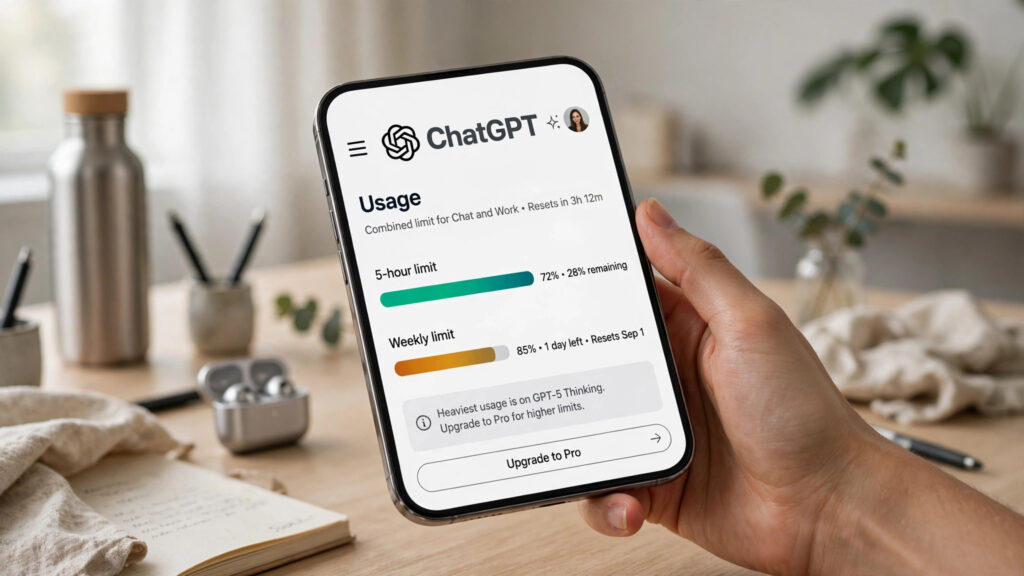
OpenAI is changing how ChatGPT usage limits work — and if you use ChatGPT heavily, you will feel it. The company is merging the Chat and Work tabs into a single experience with one shared usage meter, and it has also fixed a billing mistake that had been quietly discounting GPT-6.2 usage. The result: heavy users will hit their limits sooner, with Astra limits now running out about 40 percent faster and Sol about 25 percent faster than last week.
- OpenAI is merging ChatGPT’s Chat and Work tabs into one experience with a single shared usage limit for ChatGPT and Codex.
- The change started with a small group of Pro subscribers on November 24, 2026, with a wider rollout planned for December.
- A billing error had wrongly discounted GPT-6.2 usage at launch; after the fix, Astra limits run out about 40% faster and Sol about 25% faster.
- OpenAI is giving every Go, Plus, Pro and Business user one banked reset as an apology for the billing error.
- The Instant model stays available after your allowance runs out, so you are never fully cut off.
What the new ChatGPT usage limits mean in practice
Until now, ChatGPT’s Chat and Work experiences had separate usage allowances. That separation is going away. Under the new system, ChatGPT and Codex draw from one token pool, so frequent users of both will exhaust their shared allowance sooner than they did before. OpenAI says the change is about simplifying the experience — one meter, one place to see where you stand — but for power users the practical effect is a smaller effective allowance for each side of the product.
There is a safety valve. When the shared allowance runs out, the Instant model remains available, so you can keep chatting — just not with the most capable models. And OpenAI is adding one banked reset for everyone on the Go, Plus, Pro and Business plans, a goodwill gesture tied to the billing error it is also fixing this week.
The timing is not a coincidence. Anthropic made a similar move in September, combining Claude chat and its Cowork agent into one experience. The industry is converging on a single pattern: one assistant, one meter, and the heavy users pay more attention to how much they are using it. Our earlier report on GPT-6.2 Sol rolling out to ChatGPT covers the models at the center of this change.

The GPT-6.2 billing fix: why your limits just shrank
The second change is the one most users will notice first. OpenAI says GPT-6.2 Astra and Sol were wrongly discounted when they launched on November 18, 2026, so users were getting more usage than their plans were supposed to allow. The company has now corrected the billing, and the effect is immediate: compared with last week, you will hit limits about 40 percent faster on Astra and 25 percent faster on Sol.
That is a real cut, and it lands on the models OpenAI has been pushing hardest. Astra is priced at $8 per million input tokens and $40 per million output tokens — about 20 percent below the previous GPT-6 Astra — with cached input dropping to $0.40 per million from $1.00. Sol, the chat-optimized model, is rolling out to Plus, Pro, Business and Enterprise users, with OpenAI’s internal tests showing image understanding jumping from 47.4 to 71.7 percent. Both models are now effectively more expensive to use than they were in their first week.
OpenAI has acknowledged the mistake openly, which is more than many companies do — but the apology reset only goes so far. One banked reset is a one-time cushion, not a fix for the new, tighter limits. If you were leaning on the discounted rates, your usage habits need to change, or your plan does. The GPT-6.2 Astra and Sol launch pricing explains what the models cost and what changed.
What else is changing — and what to do about it
There is one more date to put in your calendar: OpenAI will end support for the ChatGPT Classic macOS app on January 30, 2027. If you are still on the old app, the new desktop experience is the way forward — and it is the same app where the merged Chat and Work experience will live.
So what should you actually do? First, check your current plan and how close you run to its limits — the merge means Chat and Codex usage now compete for the same allowance, so a heavy coding week can eat the budget you used to spend chatting. Second, use the banked reset wisely: save it for a week when you genuinely need the headroom, not the first time you see a warning. Third, remember the Instant model is still there after the allowance runs out, so everyday questions do not have to stop. And if you are on Plus, the ChatGPT Space rollout for Plus users is worth knowing about, since it changes what the $20 plan includes.
The bigger picture is that the free-ride phase of the AI boom is ending. Models are getting cheaper per token, but the allowances around them are getting tighter and more carefully metered. OpenAI is not hiding that — it is telling its heaviest users, directly, that the meter is now shared. Plan around it.

Frequently asked questions
What are the new ChatGPT usage limits?
Why are my GPT-6.2 limits running out faster?
What happens when I hit my ChatGPT limit?
When does the shared usage meter roll out to everyone?
Is the ChatGPT Classic Mac app going away?
The shared meter is not a bug — it is the new shape of ChatGPT. Check your plan, save your banked reset for a week you actually need it, and get comfortable with the Instant model for everyday questions. The allowances are tighter now, but at least OpenAI is telling you exactly where the line is.
Sources: The Neuron AI digest, November 26, 2026; Viewridge Security rollout brief, November 26, 2026; DEV Community news digest, November 26, 2026; OpenAI.
External links: The Neuron: Everything That Happened in AI Today, November 26, 2026 | Viewridge: Anthropic Ships Skills over MCP; OpenAI Merges ChatGPT Tabs